

 DailyPay Platform
 Small Business

 Off-Cycle Pay
 Tips
 Perks





Employee engagement strategies and ideas for 2027
Updated Nov 9, 2026 · 10 min read
Employee engagement relates to an employee’s commitment and connection to their company. To maintain a high level of employee engagement or increase employee engagement, companies often turn to an employee engagement strategy.
What is an employee engagement strategy?
An employee engagement strategy focuses on how companies can improve the employee experience by fostering higher employee engagement.
Companies with high employee engagement and successful employee engagement strategies can expect positive outcomes including improved profitability, productivity, customer service, retention, safety, and overall well-being.1
These outcomes highlight exactly why your company should invest and focus on an employee engagement strategy.
Employee engagement in 2026: The latest data
Employee engagement has become more valuable than ever.
According to Gallup’s State of the Global Workplace: 2026 Report, only 20% of employees worldwide were engaged in 2025, the lowest level since 2020 and only the second annual decline in twelve years.
The most striking shift is among managers. Manager engagement dropped from 27% to 22% between 2024 and 2025 — the largest single-year decline on record. Because managers account for an outsized share of their team’s engagement, a disengaged manager quietly pulls an entire team down with them. That makes manager enablement the highest-leverage move most organizations can make in 2026.2
Engaged vs. disengaged employees
Let’s take a look at the key differences between engaged employees and disengaged employees and how your company can benefit from adopting an employee engagement strategy.
Benefits of high employee engagement
If your company has high employee engagement, this may lead to various organizational outcomes including profitability, productivity, customer service, retention, safety, and overall well-being.3
Let’s take a look at some of the benefits of an employee engagement strategy.
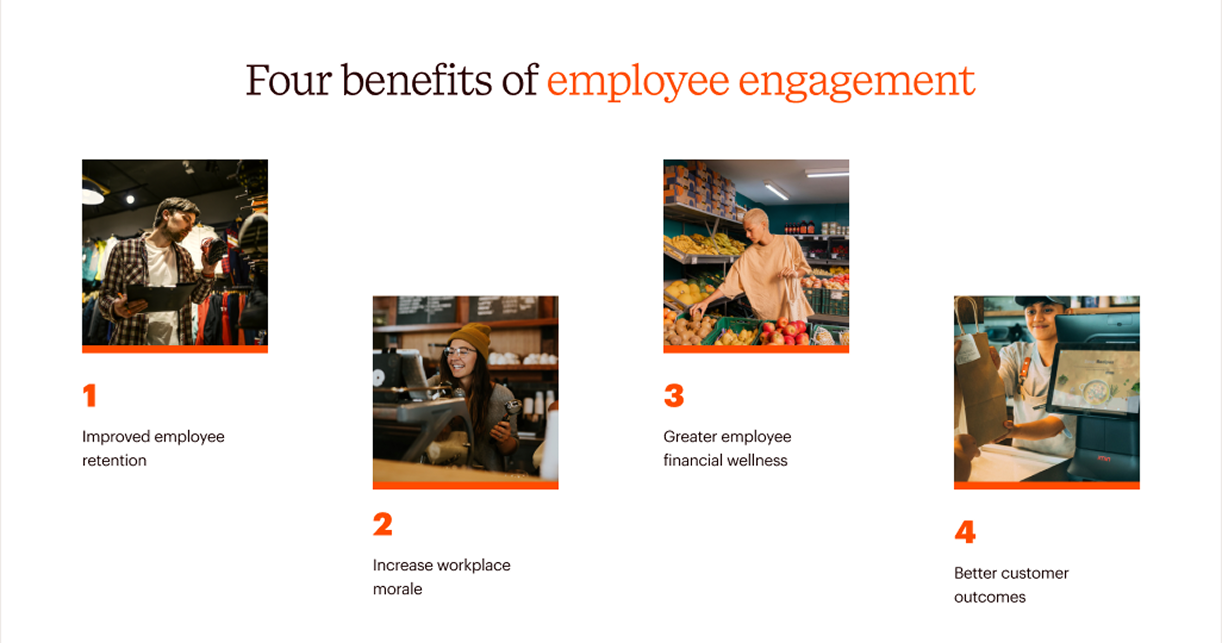
Improved employee retention
An outstanding employee experience may help employees feel valued, engaged, and supported leading to better employee retention.
A lack of opportunities for advancement and feeling disrespected at work are among the top reasons why Americans have left their jobs in recent years.
According to Employee Experience Research, Arizent study commissioned by DailyPay, 68% of users say they are more likely to stay at a job that has DailyPay.4
Increased workplace morale
Engaged employees are involved in and enthusiastic about their work and workplace. This increased involvement and enthusiasm may help contribute to a more positive workplace morale.
Greater productivity
In addition to more consistent staffing levels and a more positive work atmosphere, companies with higher employee engagement can also expect stronger yields and outcomes. In fact, 64% of employers who offer EWA are confident in their organizations ability to link EWA to measurable productivity outcomes.5
Employee engagement strategies and ideas
The benefits are clear — the question is how to earn them. The strategies below combine the fundamentals DailyPay has always recommended with the moves that matter most. Start with the ones that address your biggest gaps.
Offer richer employee professional development opportunities
Professional development opportunities such as workshops, courses, certifications, and attending industry conferences are highly prized as they contribute to career advancement and skill acquisition.
Training is a great way to show that you are invested in your employees. Training initiatives can range from career development opportunities to financial wellness education and resources. By showing that you are invested in your employees’ professional and personal lives, you are encouraging loyalty and engagement.
Offer financial wellness benefits
Offering outstanding financial wellness benefits can make a meaningful difference for employees. They can get a better hold of their finances, leading to more financial wellness and less stress.
Learn more about how the DailyPay Solution may improve employee engagement.
Offer rewards and recognition
According to Survey Monkey (in partnership with the employee recognition platform Bonusly), 82% of employees consider recognition as integral to their happiness at work and 63% of employees who are often recognized at work are less likely to look for a new job opportunity in the short term.6
Companies should consider how they can meaningfully reward and recognize their employees to show their appreciation.
Employees often value rewards that enhance their job satisfaction and personal growth beyond a salary increase. Public recognition through awards, “Employee of the Month” titles, or features in company communications can boost morale and motivation.
Health and wellness benefits like gym memberships, wellness programs, or mental health support services show a company’s commitment to employee well-being.
Additionally, perks such as extra vacation days, on-site amenities like free meals, child care facilities, or transportation benefits are also greatly appreciated. These rewards not only make employees feel valued but also encourage a loyal and positive work environment.
Leverage employee engagement platforms
Employee engagement platforms (also referred to as employee engagement software) refer to various tools, platforms, and services designed to improve overall employee engagement for a company through feedback, surveys, and other tracking tools.
Strengthen onboarding to drive early engagement
First impressions are lasting. An employee’s engagement trajectory is often set in their first 90 days — a strong onboarding experience accelerates it, and a weak one is hard to recover from.
Onboarding is not paperwork; it’s the first proof of whether your engagement promises are real. Great onboarding sets clear expectations from day one, connects new hires to their team and a workplace buddy, provides the tools and training to succeed quickly, and explains how each person’s role ladders up to the company’s purpose.
Extending onboarding well beyond the first week — with regular check-ins through the first three to six months — keeps early engagement from fading.
How to measure employee engagement
You can’t improve what you don’t measure. A good measurement program combines a validated engagement score with the qualitative context that explains it.
Track an engagement score over time
Most organizations use either an employee Net Promoter Score (eNPS) — “How likely are you to recommend this company as a place to work?” — or a short series of engagement questions covering clarity of expectations, recognition, growth, and whether employees’ opinions count. What matters is consistency: use the same questions each period so you can see the trend.
Segment the results
Company-wide averages hide the real story. Break scores down by team, manager, tenure, and location to find exactly where engagement is thriving and where it needs attention — then focus your effort there.
Watch behavioral signals
Survey scores are only part of the picture. Voluntary turnover, absenteeism, internal-mobility rates, and participation in recognition programs are all leading indicators of engagement that you can track continuously between surveys.
Employee engagement FAQs
-
What is employee engagement?
Employee engagement relates to an employee’s commitment and connection to a company. High employee engagement can lead to improved employee retention, higher workplace morale and increased employee financial wellness.
-
What do I do if my employee engagement is low and how can I improve employee engagement?
An employee engagement strategy powered by greater pay flexibility, improved benefits, training, and rewards can help companies increase employee engagement.
-
What are the benefits of increasing employee engagement?
Companies that increase employee engagement can experience higher employee retention, greater productivity, higher profitability, and more.
-
How do you measure employee engagement?
Companies can measure employee engagement through surveys, employee engagement software, and other employee engagement platforms or tools.
-
What are employee engagement platforms?
Employee engagement platforms are tools and software designed to improve employee engagement through feedback, surveys, and other tracking tools.
-
What are the most effective employee engagement tools?
In addition to improved benefits, the most effective employee engagement tools often include tracking, messaging, and survey tools to foster engagement and communication.
1, 3 Gallup: Improve Employee Engagement in the Workplace:DailyPay, 2020
2 Gallup, State of the Global Workplace: 2026 Report:DailyPay, 2020
4 DailyPay Employee Experience Research, Arizent study commissioned by DailyPay, January 2026:DailyPay, 2020
5 Defining EWA Success, Everest Group Business Decision Makers Research, April 2026:DailyPay, 2020
6 SurveyMonkey: Employee Recognition and Retention:DailyPay, 2020
All information herein is for educational purposes only and should not be relied upon for any other use. The information herein does not constitute the rendering of professional advice by DailyPay. No fiduciary obligation or duty exists, or is created, between you and DailyPay. DailyPay does not warrant the completeness or accuracy of any information provided to you.
Why top companies choose DailyPay
More control for employees
Access to earned wages when they need it, giving employees greater control over their pay.
Financial wellness tools that help employees plan, manage and make more informed decisions about their money.
An easy-to-use experience that puts pay and financial tools in one place.
Simple and secure for employers
Integrates with existing payroll and HCM systems with minimal disruption.
Built to work seamlessly across payroll, banking and benefits ecosystems.
Enterprise-grade security and reliability designed to protect data and keep DailyPay available when employees need it.